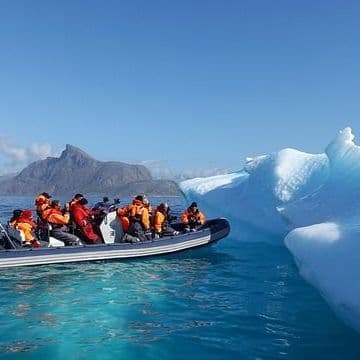
Polar Oceans Transformed as Warming Melts Ice Habitats: Research
The report says the ocean absorbed 23 zettajoules of heat in 2025 and Arctic sea ice has declined by nearly half a million square kilometres a decade.
- On Wednesday, the 10th Copernicus Ocean State Report documented record ocean heating, rising sea levels, and increased acidity, delivering its 'starkest warning yet' about profound changes in the world's seas.
- Oceans absorb roughly 90% of excess heat from fossil fuels, with the warming rate doubling over 20 years and an additional 23 zettajoules absorbed last year, setting a ninth consecutive record.
- In the Mediterranean and Black Seas, record-breaking marine heatwaves in 2024 lasted more than 30 days, driving temperatures more than 8.3 degrees Fahrenheit above average and placing regions under 'intense pressure.'
- Ocean acidity increased by around 17% since 1985, threatening shell-building animals like oysters and corals, while global sea levels rose by an average of 3.8 millimetres annually between 1999 and 2025.
- Pierre Bahurel, Director General of Mercator Ocean International, emphasized the need for sustained monitoring, stating, 'It is our responsibility to build the permanent capacity to anticipate this transformation.
56 Articles
56 Articles

Overheating, acidification, glacial melting... all the lights are red in the tenth annual report on the state of the ocean.

The ocean is changing at a frightening pace, with direct consequences for marine ecosystems, coastal zones and populations around the world – this is the main conclusion of the 10th report on the state of the oceans of the Marine Environment Monitoring Service under the EU Cooperativeus programme. "The report on the state of the oceans shows the enormous pressures our oceans are experiencing. (...) For Europe, this signal is to intensify efforts…

A new report from the European Earth observation service Copernicus is the “clearest warning yet” about the state of the oceans. The post Rising sea levels, storms and death – Copernicus report records dramatic changes in the oceans appeared first on in.gr.

Arctic sea ice shrank by about 490,000 square km per decade between 1979 and 2025, an area nearly the size of Spain, according to latest report

 Observador


Study indicates that all Exclusive Economic Zones (EEZs) of Small Island Developing States (SIDS) are affected by ocean warming since 1960
Coverage Details
Bias Distribution
- 56% of the sources are Center


Factuality
To view factuality data please Upgrade to Premium